The Calligrapher, The Books and the reasoning

calligrapher at NoelandersIn 2008 Sandro Segneri one of the invited artists at this years Noelanders Trophy was in my garden. Sandor was working at the Burrs workshop and was taking time out.

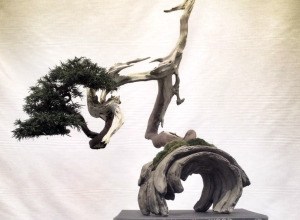
When he saw this Yew Sandro was drawn to the sweeping curves of the deadwood and likened the movement of the tree to calligraphy. I find it pretentious in naming your own trees, however I liked the name Sandro gave to this bonsai.

Finding the correct pot for this tree has not been an easy task, the tree has been potted in a number of different containers. Last year Erik Križovenský from Slovakia attended one of my workshops. He brought this unusual pot for me, it was not made especially but when I saw it I considered it to be an interesting match with this tree.

The Space available to pot the root ball is quite small, planted 18 months prior to the Noelanders trophy this tree would need to be transferred to a larger pot soon after the event.

In deciding how the tree would be presented I needed to consider the strange pot, the unusual style of the tree and its name. Terry Foster and I worked with a number of different tables and none really suited the tree. We decided to look for inspiration in the many bonsai exhibition books that I have. As we waded through the pile of books nothing presented itself as a suitable option. It was then that we noticed that pile of books and wondered if these in fact could be our table.

The original idea was to wrap the books with white covers, this would make the publications anonymous however it simply did not work. In deciding to use the books ‘as is’ made my job easier and the choice of books is key to the idea. If you look carefully at the spine of each book they all form the background to the styling of the tree.

Once this decision was made the choice of accompanying planting or supporting objects needed to be considered. An accent plant or something else, the choice of Calligraphic brushes and ink stone seemed the obvious choice.

On presenting the tree for photography at the event I was very happy with the selection of books and the colours of the binding.

The tree or should I say the display was received well with most liking what I present and making a point of telling me… and a few really not getting it!
close up of the the tree

I ventured opinions from those I valued, Peter Warren was candid stating “the focus is on the books and not the tree, even though the tree is good” and I admit on reflection he is right! Everyone talked about the books… and no mention of the tree.

When considering an unusual display the quality of the tree must be excellent and not play second fiddle and I fear this may have happened. However I was surprised that the display did not look out of place, and was somewhat disappointed that more folk did not rage against it. My old friend Bill Bailey did not mince his words “I don’t like it… but I AM a traditionalist” I also overheard this comment “if I wanted to see books I would have gone to a library” I take comfort in the words of Oscar Wilde “There is only one thing in life worse than being talked about, and that is not being talked about.”  And nobody talked about the ‘other’ tree I had in the show so I guess there IS merit in what I did.

Tom Benda Bonsai Potter and The Kifu Taxus Baccatta

Toms trade stand

Toms trade stand

I have seen the work of Tom Benda develop over the last few years however his most recent work is up there with the best bonsai potters in Europe. At the recent EDA UCHI KAI exhibition in Belgium Tom’s Trade stand was the busiest by far.My Yamadori trade stand backed onto Tom’s and we had a great weekend together. It was a classic case of “buy the pot NOW” because if you don’t somebody else would! So many pots were purchased in the first few hours of the weekend.

As he would have nothing to display the scope of his work, Tom requested that the buyers collect their purchases at the end of the show. Mario Komsta and Mark & Ritta Cooper snapped up dozens of pots between them, so often through the weekend I heard “Sorry that’s been bought by Mario”… “Mark and Ritta’s” “yes… that’s Marios too!” “no… sorry Tony Tickle has bought that”

This brings me to one of the Pots that I purchased, considered by Tom as “The best bonsai pot I have ever made” (what sales technique!) This was to be for a Kifu size Yamadori Taxus Baccata that I have been working for quite a few years. The current pot is by Milan Klika, lovely but not quite right for the tree, I will be potting the tree into the new container in April 2014. To ensure that the pot will indeed suit the tree I always produce a ‘virtual’ image.

NOTE: I am now the distributor for Toms pots and will be selling them on my stand at next years Noelanders trophy, so if you DO want to purchase one of Toms amazing Pots I suggest that you get there early

The Virtual Image

The Virtual Image

with a little temple just for fun!

Repotting the Excalibur Yew

The stone and the tree were collected together; I had no option as the tree grew through the stone. I carried the tree for just under a mile down the mountain to my vehicle… it is very heavy and I collected no more that day as I was truly knackered. I have done some work on the right side of the stone as I wanted to expose some more of the trunk line, this has now weathered and is indistinguishable from the rest of the stone. The combination were collected in 2009 and the tree has thrived over the last few years, even though the tree is very slow growing the canopy is developing well and should become a pleasing bonsai in time, a dwarf rhododendron is planted at the front to break up the ‘wall’ of stone. .

How the tree looked when first collected

How the tree looked when first collected

with a little temple just for fun!

with a little temple just for fun!

Progressive styling on the Tall Yew

Today I did the progressive styling on the Tall Yew.  The tree is now well established in the pot and has a strong root system that’s developing sturdy branches and a lot of foliage. With the help of a hot summer and careful feeding regime the tree is growing well.

The Progressive styling

The Progressive styling

I removed about 30% of the foliage, and wired the rest. I grew a branch at the rear of the tree and replaced the previous one on the lower right because it was brought down from the crown and I was not happy with the structure. This branch now needs to thicken and ramify, the branches are left uncut to grow long, and these will be cut back at the end of the growing season. The lower left branch is well underway and has been cut back to a few needles. Where I want back budding I have removed the inner needles on three year old wood

Due to the vigorous growth the wire will be removed next Autumn just prior to the branches thickening, this growth has also helped the thickening of the live vein.

Branches left to grow to thicken

Branches left to grow to thicken

Branches trimmed to force ramification

Branches trimmed to force ramification

Inner needles removed to encourage back budding

Inner needles removed to encourage back budding

Thickening of the live Vein

Thickening of the live Vein

When the tree was collected in 2007

When the tree was collected in 2007

touching the deadwood 2

Among the Ancient Yews of Borrowdale

Earlier this month I made a pilgrimage to Borrowdale in the Lake District, a beautiful area and home to some of the most amazing trees in the UK. I went in search of some amazing ancient Yew trees, described by the Poet Wordsworth as ‘the Fraternal Four’ – though there are now only three.

Tony with the oldest of the Yews

“But worthier still of note
Are those fraternal Four of Borrowdale,
Joined in one solemn and capacious grove;
Huge trunks! -and each particular trunk a growth
Of intertwisted fibres serpentine
Up-coiling, and inveterately convolved, -
Nor uninformed with Fantasy, and looks
That threaten the profane;”

It is hard to believe that these three trees are not signposted, despite one of the trees being named by the Tree Council and selected as one of the 50 Great British Trees recognised to celebrate the Queen’s Golden Jubilee in 2002. Difficult to find the only ‘threat’ to these trees being the 140 inches of rainfall and the harsh growing conditions. I took with me a superb account from Toby Hindson (you can download it here) who in 2012 recorded in detail the condition of the remaining trees.

dry River bed walk inWe arrived in the Borrowdale valley armed with our directions yet still found them difficult to locate, I called to a group of walkers across a field of grazing sheep “are you searching for the Yews?” not realising that they probably thought “Ewes”… Carolyn was in hysterics.

After consulting the OS map we identified the location and set off alongside a dry river bed, the hillside was deep with ferns and dry as tinder. The route up the Trees is over granite Talus and they are growing on and between the large stones, the largest tree growing over a large rounded boulder.

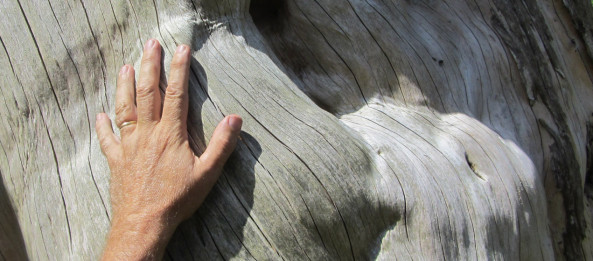
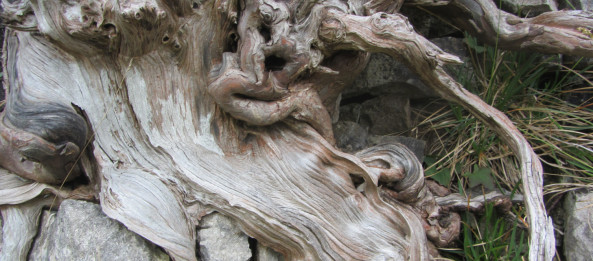
Inside a hollow with new growth in the canopyThe three trees grow close to each other and create a strange mystical atmosphere under the canopy. I had an amazing feeling of euphoria during the whole time I was among the ancients, my friends simply could not believe that they were stood in visible history, they too were entranced.  In 2005 the crown of the oldest tree literally ‘snapped’ off. It lies alongside the bulk of the tree as a white skeleton. The deadwood on the main tree is something to behold, bleached white by the sun it’s a great model for bonsai. All the trees are hollow the oldest is so large that 6 persons can easily stand inside, the other two trees display copious deadwood that is not bleached white but rotting brown. All have low hanging branches that are regenerating.

In the book “The Sacred Yew” Alan Meredith considered these trees to be Neolithic, the National Trust approximately 2500 I am with Meredith, these trees are ancient. From my own experience and visits to many old and ancient Yews in the UK including the Fortigall Yew at Glen Lyon, these trees may well be over 5000 years old.

Next time you venture into the Lake District take the time to visit The ancients, you will not be disappointed.

Cutting needles

How to create dense foliage mass on Yew Bonsai

It is important to know when to cut back and create good ramification. Planning the structure of your tree is critical in the early stages, even though the silhouette of the tree may look luscious and full, the structure and therefore the future quality of the tree will be compromised. The ‘pig tailing’ long branches and trimming the outline of the tree is a practice that must be stopped if our bonsai are to reach a high level.

Plucked needlesBack budding is created on ‘third’ year growth, in 2013 this means that branches that were grown in 2011, so in the early stages of creating the foliage ‘clouds’ you are working on three year cycles.

If you cut back too early the strength of the tree is weakened, the best time is when the new growth is approx 5 inches or approx 20cm long, trim back to between 12 and 20 needles. This growth will have thickened the branch and stimulated good root growth, and trimming in July ensures that there is enough time for the tree to make new buds both on the trimmed area and further back down the branch.

To encourage new back budding pluck the needles on the third year’s growth, this will throw out masses of strong new growth before Autumn ready for the following year.

New feeding regime is working well

I am pleased to say that my new feeding regime is working well with the growth on this yew, these photos were taken one year apart. I will be cutting back next month to encourage internal growth and in couple of years this tree can be styled.Tall Yew one years growth

yew Banner

Amazing Yamadori Yew that will NEVER be collected Video

deadwood Yew Over the last 25 years I have collected many amazing Yamadori, in all that time I have NEVER discovered a tree quite like this Taxus Bacatta that was growing half way down a limestone cliff. The amazing deadwood and twisting live vein gave the tree an incredible ancient presence.

I believe that very few people… maybe none has ever seen this tree as it’s in a VERY inhospitable, almost inaccessible location, it has survived many hundreds of years… I wanted this tree, but I also felt a deep sense of respect for this ancient survivor… so that’s where its staying.